
Stunning Castle Hill - Kura Tawhiti
- May 9, 2025
- 3 min read
Monday 28 April
Woke early to catch a beautiful sunrise - it was so worth it!


The chooks paid us a visit so we thanked them for the eggs we had bought off Barrie and scrambled 3 of them for breakfast 🥚🥚🥚


I set off to walk around the hill beside Cass and Louis went off biking to Lake Grasmere and we met on the road back. I did a bit of civic duty and came back laden with empty cans and beer bottles that people on the road had just hurled onto the verge... not a very tidy kiwi then! Back at Banjo we had a quick lunch then drove over to Castle Hill Rocks which we had last visited with Ella & Josh in June 2023.
The drive over went through some glorious landscapes - past the hourglass shaped Lake Pearson, through beautiful pastoral valleys, across the Broken River and alongside hills scattered with karst boulders. The vastness of the mountains and the cascading gorges of scree were yet another reminder of O'Level geography lessons.


We arrived at Kura Tāwhiti (Castle Hill) mid afternoon but already the sun was lowering in the sky casting glorious shadows over the area. Hewn by eons of rain, wind and groundwater, Castle Hill is an archetypal karst landscape, a monument to an era long past. Mementos of its former life on the bottom of the sea maybe 30 or 40 million years ago can be seen in a random fossil, but today's monolithic rocks have been eroded into shape by seawater & rainwater over the passage of time.


The geology of the rocks at Kura Tāwhiti (Castle Hill) is tertiary limestone, mudstone, sandstone and tuffs. Limestone is formed from layers of organic sediment, deposited in deep oceans far from land. The layers are compressed into soft, soluble rock. Pressure over time caused extensive uplift and folding and faulting of the Torlesse and Craigieburn ranges In places you can see deep cracks between the rocks, or they may have drifted apart over time or hollow caves or arches formed, creating natural frames for the surrounding landscape.







I was absolutely fascinated by the yellowy sandstone inverted teardrop which was perched high up on a vast grey stone karst - how did it form like that, how is it balanced, why is it so different from the surrounding rock?
The rocks are dotted with dips and dents, forming. natural handholds which make it popular with climbers and boulderers. I chatted to a pair of guys trying to climb a relatively small karst in the midst of the rock formations - I asked if i could video them for Amy as she loves bouldering; I sent her the video and she recognised one of the guys from Boulder Co in Auckland - such a small world! In the last photo on the left above there is a small dot in the centre - it is a man sitting atop the rocks, giving a true sense of perspective on their magnitude.

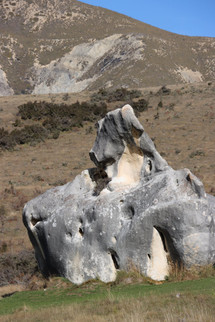


The grand limestone outcrops of Kura Tāwhiti hold great cultural significance for Ngāi Tahu. There is acknowledgement of this Maori heritage in the beautiful information stands decorated with koru and traditional carvings, and the three pou unveiled in 2022 - one figure faces and greets those entering the grounds, another acknowledges the maunga (mountains), and another the large limestone boulders that have made the site so internationally renowned.
I wish we could have stayed for golden hour and sunset - that would have been even more amazing ❤️ We will have to come back another day!


Back to Cass and we disturbed the large harrier that had been feasting on a kill outside the campsite all day. I had tried to photograph him earlier, but ever alert, he would take to the skies the moment I moved into his eyeline behind the hedge... apparently in a car I was far less scary!
We were just in time for one last happy hour and more fantastic tales from Barrie about life on the railways, before we patched together dinner from our dwindling food supplies - thanks Ella for the scallopini, they are still going strong!


Comments