
Historic Hayes Engineering
- May 5
- 5 min read
Sunday 26 April
Several people we’d met on our travels had raved about Hayes Engineering, and we were as close as we were going to be for the foreseeable future so we bit the fuel price bullet and set off for Oturehua in the Ida Valley.

A quick stop at Muddy Creek in Omakau for a ginger crunch then off the beaten track and into the Ida Valley.
Historic Hayes Engineering is a phenomenal experience - Ernest Hayes arrived here from England in 1884 was the original Kiwi innovator. A millwright by trade, he re-invented himself when the railway came to Central Otago and almost overnight killed off demand for locally-produced flour. At his Oturehua farm, he built an ever expanding workshop & set about devising a series of brilliantly handy agricultural tools, from rabbit bait cutters to wind turbines to fence wire strainers. He fathered 9 children with his wife Hannah, who was his greatest supporter & saleswoman. She cycled all over Otago with samples of his products, taking orders. He embodied the kiwi No.8 wire philosophy - spotting a problem or gap in the market and solving it creatively. Ken Gillespie has been part of the Hayes story for over 3 decades, keeping the machinery of the workshop running and curating & sharing the Hayes history and he was our tour guide.
The tour kicked off at 1.30pm and we just had time to grab a quick lunch from Hannah's Kitchen (named for the first Mrs Hayes) while Ken harangued all the other cafe customers, hoping to rustle up some more takers for the afternoon tour - he was quite the character.


The tour began at the Hayes Office - some of Ernest’s multitude of agricultural and other inventions were on display, along with a complex family tree and other old machinery. Many early inventions revolved around farming - fencing in particular. Hayes designed, patented and manufactured several versions of wire strainers which tightened fence wires to prevent stock escaping, as well as iron fence posts and specialised hinges.
His wife Hannah cycled for miles promoting his new inventions - early bicycles had wooden wheels and no suspension so were super uncomfortable especially on the rough ground of Central Otago, so Ernest patented a double tyre bike wheel on a metal frame. The idea never came to fruition, but more recently this prototype was created and gifted to the collection.


Once we’d learned about his inventions, we headed over to the heritage workshop. The old building was packed with heritage machinery all linked together by axles, belts & wheels, each machine created to handle a different, and often specific, job.
Early power was wind or water driven, later battery power was pressed into use in the workshop. The machinery included a wood lathe, a drill stand, a hoop bender and many more.





It was cold in Otago - both then & now - so Hayes built a machine for sharpening ice skates! In the office Louis had checked out the scale sales model of Hayes’ fencing wire winder - in the workshop Ken showed us the real thing as made over 100 years ago. Meanwhile, in the forge, Hayes created a drill for mending a broken anvil! You really could hardly see the join… Some of the inventions and specifications were a little beyond our comprehension as non-farming stock - Louis did his best to look knowledgeable!


The workshop was filled with fascinating old bits and bobs including drawers full of specific screw or bolts, a thick old rope wrapped tightly round an axle to act as a gear, an old electric boar, many stencils for product boxes and cases and many, many old cans and tins of oils and chemicals.
The inventions were sometimes simple - like this wee gadget which was a seed drill - seeds go in the can, there are holes around the edge then the wheel creates a narrow gully that the seeds drop into at regular intervals. Hayes had his ideas made up in wood before the moulds could be made for metal pouring - the detail of the wood prototype was incredible.


Wood was a scarce resource in Central Otago due to geological movement & climate changes - so bricks were created from mud, cow dung, tussock grass and tallow in these large wooden frames, dried in the sun then cemented into place and painted. Struts of treated timbers - visible here as black squares - were built into & through the walls to support the heavy machinery and benches inside.
We found the tour absolutely fascinating (even though we weren’t 100% sure of all the machinery’s exact functions) and after guiding us through the dark & oily workshop one way, Ken’s colleague fired up the engines and we came back through, watching all the machinery in action - cogs whirring, leather belts circling, all the machinery powered from one single source of power.
Whilst outside we checked out the tumbler which was used to clean and de-rust old metal implements that were melted down for recycling ♻️ No active demonstration as it is stupendously loud! Ken said he could hear it from his farmhouse about half a km away!
The metal grey box on legs is all that’s left of the original Hayes windmill - but now it is powered by a Pelton wheel and water from the race 60feet up the hill. A Pelton wheel is like a reverse waterwheel where water drives the scoops at the bottom of the wheel, pushing them upwards, rather than the buckets in a regular waterwheel catching water at the top and rotating downwards due to gravity (I think!)
It's hard to see in a still shot, but at this point, the power had been switched on and all the machinery was working, wheels & cogs spinning and belts driving the machinery throughout the entire workshop.


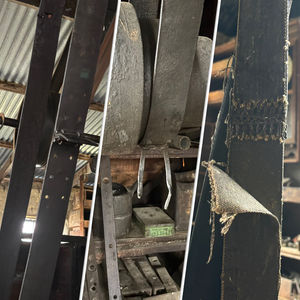


The forge was heated by gas and the bellows operated by machinery to control the heat. The belts were generally made of leather and joined by laces, hinges or stitching. Some belts were crossed so these ones had to be flat stitched. Ken showing us how the belts for each machine could be moved left or right onto active or stationary wheels above to start or stop each machine individually.
Thanks Ken - that was an absolutely fascinating tour - what a privilege! PS - loved the clock with the dodgy number seven...


After the clatter and roar of the workshop, the peaceful sanctuary of the homestead was a joy. Well restored and refurnished with many original heritage items, it was fascinating to see how the family lived over a century ago. Outside the homestead were two fountains made from the millstones from Ernest Hayes’ original flour mill.
In the old laundry - on the wall above the boil pot was a lever for starting and stopping the power to the house from the windmill over by the workshop.


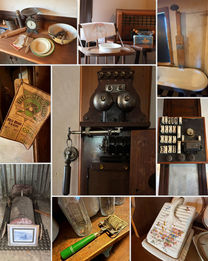

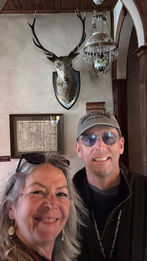



We received this lovely comment on our Facebook post about our day at Historic Hayes - from Barbara Hayes "Ken is a treasure of Oturehua! My husband is the youngest Hayes to live in the house. My late mother in law was so pleased to have helped dress the house. Its wonderful to have the family heritage preserved so well. Hope you have visited E Hayes and sons in Invercargill."
The cafe was about to close as we finished our tour - these ginger creams were too good to resist so we nabbed two for the journey home - oops!
Back at Springvale, Louis went back to his “Stranger Things” binge and I went for a walk along McArthur Road - between the almost empty vines - while Jonny cooked us a delicious pork roast dinner with extra crackling! Yum!


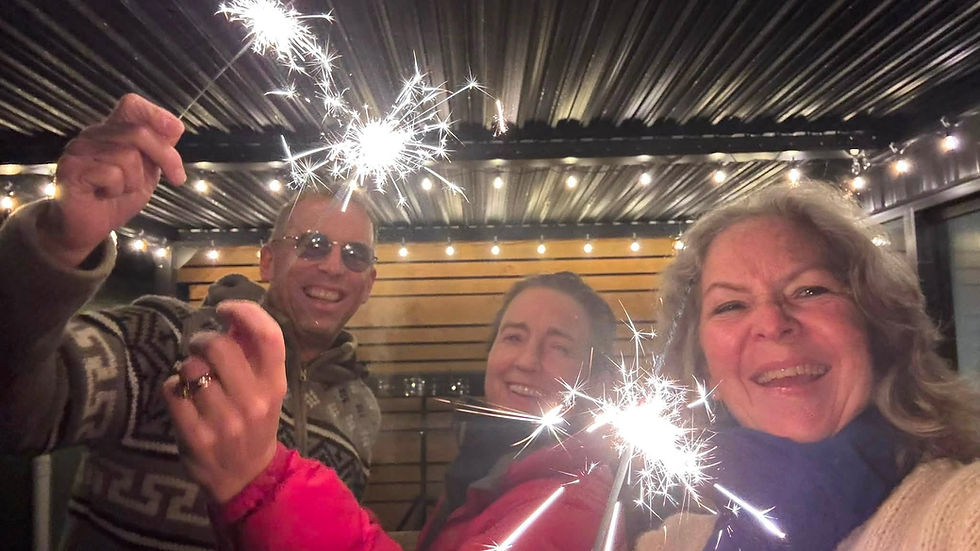
Jonny's mission it appears is to make the most embarrassing faces on our dinner selfies - I reckon this one is a winner!


Comments