
Autumn Sunshine in the Catlins
- May 28, 2025
- 4 min read
Saturday 24 May
Saturday report part 2 - after sunrise at Curio Bay we returned to base for breakfast before heading off westward to explore some more of the beautiful Catlins region.
Our first stop was Curio Bay’s petrified forest - a rare sight where trees that became fossilised around 170-180 million years ago have now bern revealed by the sea’s constant erosion of the rocks that encased them. Some of the fossils are felled tree trunks pointing out to sea, others are tree stumps encased in rock, displaying a golden stone colour and age rings that can still be counted. Our timing was not the best as the tide was half in half out, but we were still able to wander amongst these Jurassic marvels that are now protected from fossil hunters.





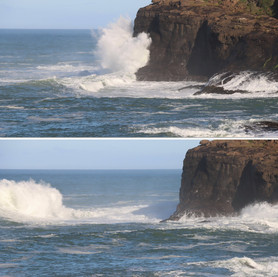
The plateau of the bay is also the landing space for NZ's Hoiho yellow eyed penguins who sail in on the evening tides then hop over the petrified forest to their homes & burrows in the flax covered rocks around the cliffs. We were a little late in the season to see any of these guys (again) but will return to try and see them at another season. The area and Porpoise Bay are also home to a resident pod of Hector's dolphins, though we were not fortunate enough to spot any on this occasion.



Moving on we circled round via Fortrose, past the estuary mouth where the 1886 wreck of the steamship Ino can often be seen at low tide - again, the tide was a little too high as we passed, but the glassy waters of the estuary were very beautiful - and on to Slope Point which is actually the most southerly point of mainland NZ (take that, Stirling Point, Bluff!) and usually one of the windiest places… but not when we were there.
It was lovely to see another of the Matariki pathway pou here, this one was fittingly dedicated to Ururangi - the star dedicated to winds and atmospheric conditions. Walking out to the marker sign on the point I was struck by the fact that the latitude here was 46 degrees, 40 minutes and 40 seconds South - which highlighted how top heavy our globe is. Studying at St Andrews back in the 80s we were conscious that the latitude there was only 10 degrees shy of the Arctic circle at 56 degrees - and yet this is quite a southerly part of Scotland, with Unst reaching 60 degrees north. Only Chile and Argentina have continental landmasses which are as far south as 46 degrees.


From here we continued eastward through Weirs Beach (a bit of a let down, more of a sandy strip on a lagoon egde) where we spotted a seal, looked for Haldane Bay which was stunning from afar but unreachable, drove through some beautiful rural , green, rolling landscapes, past a fortress of stacked silage bales, and came back to Niagara for lunch at the vans. Our resident kereru was waiting in the kowhai tree once again!


The weather was so stunning we took lunch at the giant cotton reel by the NZMCA shed in the sunshine - Harley was wondering where his bowlful was!

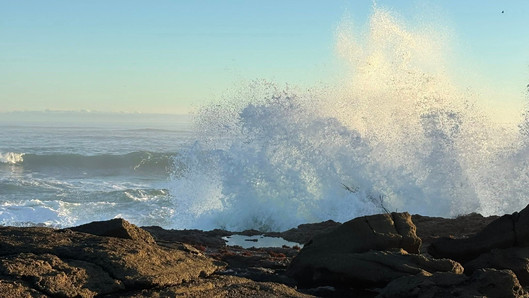
After a siesta for us and a dog walk for Tomkinsons (to the jokily named Niagara Falls), we drove westward again to Waipapa Point to see the historic 1884 lighthouse - though to be honest we were mesmerised by the pounding waves on the rocks around this wild coastline rather than the lighthouse! Following a fatal shipwreck off this coast in 1881 wth the loss over over a hundred lives, this was one of the last wooden lighthouses built in NZ and opened in 1884; a manned lighthouse for many years, the lantern was converted to solar power in 1988 with further upgrades and renovations in 2008.
We spent a while trying to identify which of the dark mountainous shapes on the horizon was Rakiura, Stewart Island, then wandered over to the lighthouse to find a gorgeous big sea lion basking in the sunshine on the pathway - causing havoc for pedestrian through traffic with its 10 or maybe 20 metre exclusion zone!








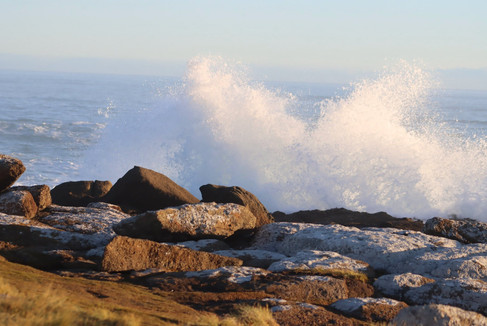
All around Waiapapa Point the waves crashed in - some of them breaking early at sea as they rolled coastward, but many pounding onto the rocks and exploding skywards. Looking west into the sun as it lowered in the sky, the waves, mist and coastline created an almost sepia tone - line a Victorian photograph. The power and strength of the Southern Ocean cannot be underestimated, and creates a newfound sense of awe at the bravery of Victorian immigrants tackling this area by sea - I presume most of the earlier Maori emigrated here overland as I could not find any historical references to waka arrivals, just to land based travel & settlements.






Coming home we were greeted by a couple of calves on the main road so shooed them into the side road where we found several other limboing under their electric fence so set off to find the owner. We did not find the owner, but did find a neighbour who shook her head ruefully and said that they escape from this roped off feeding area every year so she'd have another word with them!






We had planned to be back at Curio Bay for sunset again, but the escapee cattle adventure put paid to that idea, however the skies behind us as we wended our way eastward were very beautiful regardless.
Back home under cover of darkness for dinner in the Moho. Wonderful day!


Comments