
A Change of Scenery - Nelson Lakes
- Jan 15, 2025
- 3 min read
Monday 6 January
Monday was Jeremy’s back to work day - fortunately he works remotely most of the time so was able to log in from here and look after Harley too - as the rest of us set off to see the Nelson Lakes…
The skies were blue but streaked with the most incredible cloud formations - hopefully none of these would foretell any bad weather... fingers crossed.

We packed a picnic of wraps and fruit and set off for the Nelson Lakes, more specifically, the other Lake Rotoiti (not the one near Rotorua - Rotoiti is just Māori for "small lake"). Just over an hour away through amazing scenery and beautiful sunshine - it was a good indication of how sparse South Island population is - in almost 100km we never saw a store or a petrol station until we reached St Arnaud. For around 30-40 kilometers we still drove through vineyards belonging to a number of famous names in the Kiwi wine industry including Kim Crawford & Matua as we followed vaguely along the path of the Wairau River which we crossed over a couple of times. but eventually the landscape began to change as we climbed gently higher and higher to reach St Arnaud, 650m up in the mountains.


Lake Rotoiti was stunning - see hundreds of pics below! Set in the Northern end of the Southern Alps, with mountains, formerly glacial valleys and hiking tracks all around, the Nelson Lakes National Park was created in 1956 to protect this beautiful area.


We braved the midges and the ankle-breaking stony beach, dibbled our toes then set off for a walk round the promontory to the right of these pictures. The route followed the shoreline much of the way, with vistas through the beech forest and the occasional rocky path down to more pebbly beaches - each of which afforded new and stunning perspectives on the lake - ably assisted by the sun which was gradually burning away much of the initial cloud cover.





The beech woods were populated by various birds including waxeyes, tui and the enchanting piwakaka or fantails. One of the latter spent several minutes entertaining or distracting us - but they are so quick my attempts to film it darting here and there were absolutely hopeless!


It was interesting to see the fungus and lichen which grew along the rocks and on the trees - some of the beech trees looked like they had been burnt, but were actually covered in a a fungus called Scorias Spongiosa or more commonly sooty mould. It is harmless on the trunks, but when it spreads to the leaves it prevents photosynthesis and gradually kills the tree. The sooty mould often had what looked like Toby hairs growing out of it, but they were actually long, translucent tubes emerging from the mould, with a drop of honeydew at the end. Apparently you can lick the droplet and it is very sweet - we were not tempted!
There was also lots of Mānuka growing along the shoreline, a genus of myrtle or tea tree native to New Zealand and Southern Australia which is the source of the miraculous Mānuka honey which we proudly export. Its pink and white flowers are so pretty at this time of year.


Back at the main beach, after an informative visit to the Information Centre, we braved the midges for a picnic, watched a black swan swim imperiously along the shoreline and finally braved the chilly waters for a dip! Louis went for a long swim and spotted a giant eel… fortunately, we didn’t!
At the Information Centre we had discovered that Mt Robert road went up the side of the nearby mountain that bore its name, so we cheated and drove up for the most majestical views - wow!


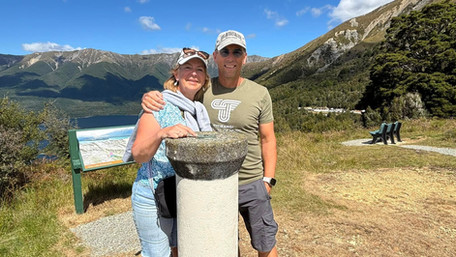





Then gave two German hitchhikers a lift back down the mountain - I’m in payback mode for all the lifts I was given in 1989!!!
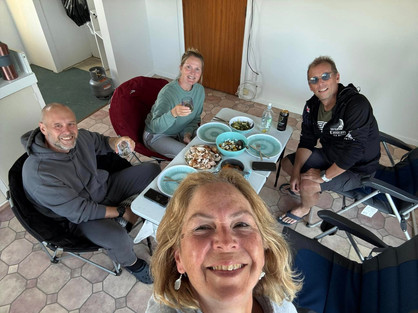
Back at Banjo, it was gin o’clock as we roasted another chicken on the Weber then dinner in the kitchen & more Ted Lasso.



Comments